
Poco F7 vs Redmi Note 15 Pro+
Compare sourced specifications, release dates and prices. CoreInfo does not declare a universal winner.
 Xiaomi
Poco F7
₹35,999
Higher spec-score estimate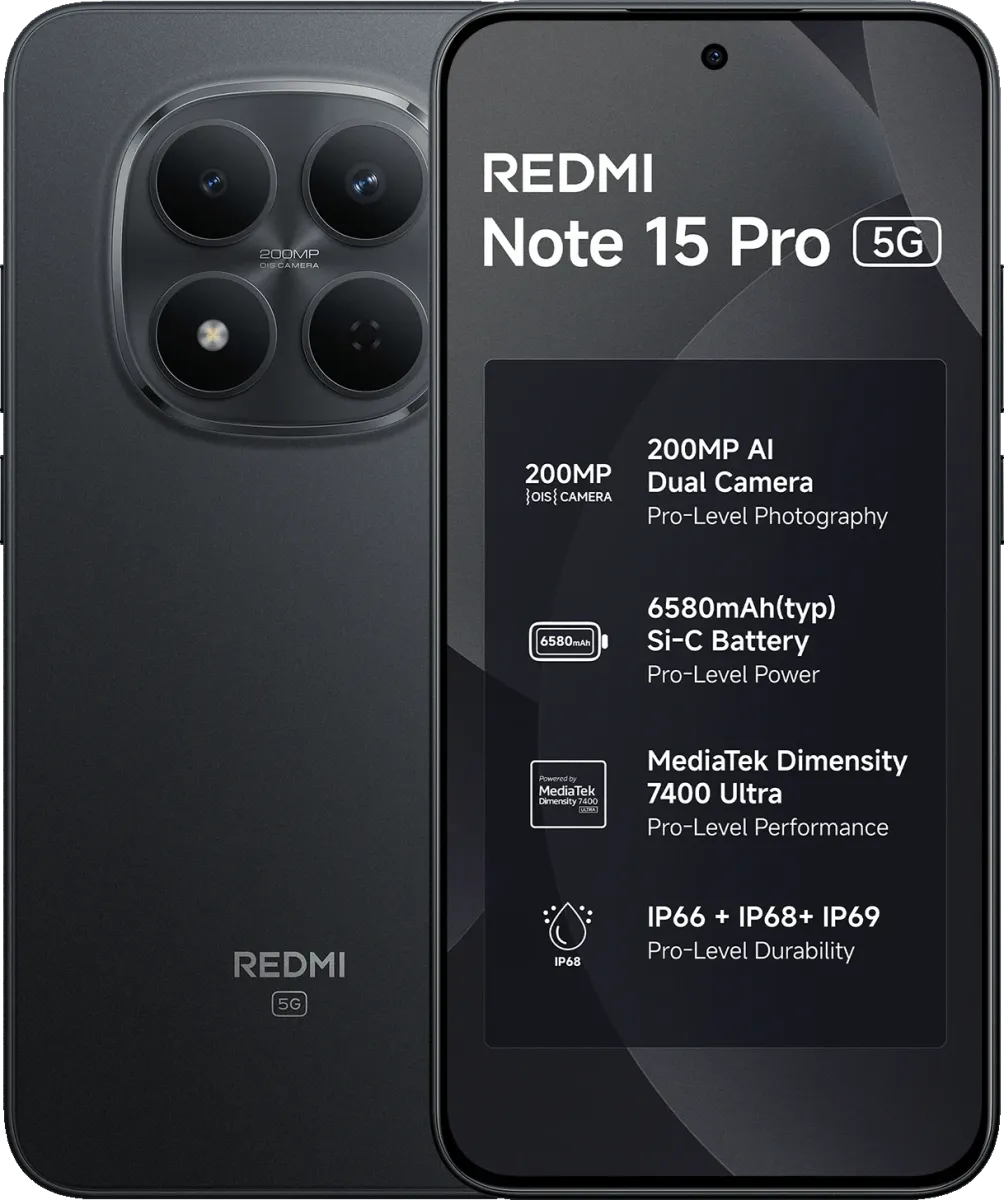 Xiaomi
Redmi Note 15 Pro+
₹39,999
Specification Comparison
| Feature | Poco F7 | Redmi Note 15 Pro+ |
|---|---|---|
| Launch Date | July 2025 | June 2025 |
| Display | 6.83 inches, OLED, 120Hz | 6.83 inches, AMOLED, 120Hz |
| Processor | (the faster chipset tier)Qualcomm Snapdragon 8s Gen4 | Qualcomm Snapdragon 7s Gen4 |
| RAM | (higher on this row)12 GB | 8 GB |
| Storage | (higher on this row)512 GB | 256 GB |
| Main Camera | 50 MP ƒ/1.95 (Wide Angle) · 8 MP | 200 MP ƒ/1.7 (Wide Angle) · 23mm (wide), 1/1.4", 0.56µm, multi-directional PDAF, OIS · 8 MP ƒ/2.2 (Ultra Wide) · 15mm, 120˚ (ultrawide), 1/4.0", 1.12µm |
| Front Camera | 20 MP (Wide Angle) | 32 MP ƒ/2.2 (Wide Angle) |
| Battery | (higher on this row)7550 mAh | 6500 mAh |
| Operating System | Android v15 | Android v15 |
| Price | (the lower stored price)₹35,999 | ₹39,999 |
| Type | Non-Removable Battery, OLED, Smartphone | Non-Removable Battery, AMOLED, Smartphone |
| Charging | 90W Flash Charge, 22.5 W Reverse Charging | 100W Fast Charging, 22.5W |
| Capacity | (higher on this row)7550 mAh | 6500 mAh |
| Weight | 222 g | (lower on this row)207 g |
| Dimensions | 77.93 x 163.1 x 7.98 mm | 78.3 x 163.3 x 8.2 mm |
| IP Rating | IP66 + IP68 + IP69 | IP66 + IP68 + IP69 + IP69K |
| SIM | Dual Sim, GSM+GSM, Nano+Nano SIM | Dual Sim, GSM+GSM, nano SIM + nano SIM or nano SIM + eSIM |
| Video | 4K @ 60 fps UHD, 1080p @ 60 fps FHD, 4K | 4K @ 30 fps UHD, 1080p @ 60 fps FHD |
| Features | Yes, Ring Flash, 3200 Nits Peak Brightness, Dolby Vision | Yes, LED, 3200 nits Peak, HBM 1800 nits, HDR10+, Dolby Vision |
| 5G | Yes | Yes |
| Network | Yes | Yes |
| VoLTE | Yes, Dual Stand-By | Yes, Dual Stand-By |
| WiFi | Wi-Fi 7, Supports 2.4 GHz and 5 GHz Dual Band | Yes, with wifi-hotspot |
| Bluetooth | Yes, v6.0, A2DP, LE | Yes, v5.4, A2DP, LE |
| NFC | Yes | Yes |
| USB | USB-C v2.0, USB Tethering, USB on-the-go, USB Charging, USB Storage | USB-C v2.0, USB on-the-go, USB Charging |
| GPS | Yes, with A-GPS, AGPS, GLONASS, BEIDOU, GALILEO, QZSS, NAVIC | GPS | AGPS | Glonass | Beidou | Galileo make wireless Down Wireless network | Data network | Sensor Assisted Positioning |
| Other | Yes, Ambient Light Sensor, Proximity Sensor, E-Compass, Accelerometer, Gyroscope, IR Blaster, WildBoost 4.0, Wet Touch Control, Circle to Search, GPT-powered AI Features, On-gallery AI, LPDDR5X, UFS 4.1 | Yes, Proximity sensor | Ambient light sensor | Accelerometer | Electronic compass | IR blaster | Gyroscope, Xiaomi T1S Tuner, Xiaomi Offline Communication, Al Writing, Al Speech Recognition, Al Interpreter, Al Search, Al Dynamic Wallpapers, Al Creativity Assistant, and more. Circle to Search with Google, Google Gemini information, UFS 2.2 |
| Size | 6.83 inches, 1280 x 2772 pixels, 120 Hz | 6.83 inches, 1280 x 2772 pixels, 120 Hz |
| Protection | Corning Gorilla Glass 7i | Corning Gorilla Glass Victus 2 |
| Refresh Rate | 120Hz | 120Hz |
| Fingerprint | Yes, In Display | Yes, In Display |
| Release Date | June 24, 2025 | December 18, 2025 |
| Model | MZB0K1OIN | 2510ERA8BG |
| Card Slot | No | No |
| Chipset | Qualcomm Snapdragon 8s Gen4 | Qualcomm Snapdragon 7s Gen4 |
| CPU | 3.2 GHz, Octa Core Processor | 2.7 GHz, Octa Core Processor |
| GPU | Adreno 825 | Adreno 810 |
| UI | HyperOS 2.0 | Xiaomi HyperOS 2 |
| Updates | 4 years | 4 years OS updates, 6 years security updates |
| 3.5mm jack | No | No |
| Water Resistance | - | 1.5 m up to 30 min |
| Speakers | - | Dual Stereo, 400% Volume Boost, Dolby Atmos | Hi-Res |
Shaded cells mark the higher stored value on that row - and the lower one for weight and price. Rows where the better choice depends on what you want, such as panel type or operating system, are left plain. This is a reading aid, not a verdict: how the comparison works.
Specification strengths: Poco F7
- Extra-large 7550 mAh battery for multi-day endurance
- 12 GB RAM for excellent multitasking
- Capable 50 MP ƒ/1.95 (Wide Angle) · 8 MP main camera for quality shots
- Vibrant OLED, 120Hz display with deep blacks and rich colors
- Expansive 6.83-inch display for immersive viewing
- Flagship-tier Qualcomm Snapdragon 8s Gen4 for top performance
- Generous 512 GB storage for apps, media and files
- Dust and water resistant for durability
- Quality audio with 3200 Nits Peak Brightness, Dolby Vision
Specification strengths: Redmi Note 15 Pro+
- Extra-large 6500 mAh battery for multi-day endurance
- 8 GB RAM for solid multitasking
- High-resolution 200 MP ƒ/1.7 (Wide Angle) · 23mm (wide), 1/1.4", 0.56µm, multi-directional PDAF, OIS · 8 MP ƒ/2.2 (Ultra Wide) · 15mm, 120˚ (ultrawide), 1/4.0", 1.12µm main camera for detailed photos
- High-quality 32 MP ƒ/2.2 (Wide Angle) selfie camera
- Vibrant AMOLED, 120Hz display with deep blacks and rich colors
- Expansive 6.83-inch display for immersive viewing
- Capable Qualcomm Snapdragon 7s Gen4 processor for daily use
- Dust and water resistant for durability
- Quality audio with 3200 nits Peak, HBM 1800 nits, HDR10+, Dolby Vision
Considerations: Poco F7
- No significant drawbacks for most users
Considerations: Redmi Note 15 Pro+
- No significant drawbacks for most users
Strengths and considerations are derived from the listed specifications, not from independent lab tests or user reviews.
Spec-score comparison
Poco F7 has the higher CoreInfo spec score, a specification-derived heuristic rather than a measured benchmark. The Poco F7 lists the Qualcomm Snapdragon 8s Gen4 while the Redmi Note 15 Pro+ lists the Qualcomm Snapdragon 7s Gen4. The sourced price is ₹35,999 for the Poco F7 and ₹39,999 for the Redmi Note 15 Pro+. Compare the stored fields below against your own priorities.
Frequently Asked Questions
What are the main differences between Poco F7 and Redmi Note 15 Pro+?
Poco F7 features the Qualcomm Snapdragon 8s Gen4 with 12 GB RAM, while Redmi Note 15 Pro+ comes with the Qualcomm Snapdragon 7s Gen4 with 8 GB RAM. Poco F7 has a 6.83 inches display, while Redmi Note 15 Pro+ has a 6.83 inches display.
What camera does each device list?
The Poco F7 lists a 50 MP ƒ/1.95 (Wide Angle) · 8 MP main camera; the Redmi Note 15 Pro+ lists a 200 MP ƒ/1.7 (Wide Angle) · 23mm (wide), 1/1.4", 0.56µm, multi-directional PDAF, OIS · 8 MP ƒ/2.2 (Ultra Wide) · 15mm, 120˚ (ultrawide), 1/4.0", 1.12µm main camera. These are published specifications, not measured image-quality results.
What battery capacity does each device list?
The Poco F7 has a 7550 mAh battery, while the Redmi Note 15 Pro+ has a 6500 mAh battery.
How do the listed prices compare?
The Poco F7 is priced at ₹35,999, while the Redmi Note 15 Pro+ costs ₹39,999.
How do I choose between Poco F7 and Redmi Note 15 Pro+?
Start with the fields that matter to you: display size, processor, memory, storage, camera, battery and price. Poco F7 has the higher CoreInfo spec score, a specification-derived heuristic rather than a measured benchmark. The Poco F7 lists the Qualcomm Snapdragon 8s Gen4 while the Redmi Note 15 Pro+ lists the Qualcomm Snapdragon 7s Gen4. The sourced price is ₹35,999 for the Poco F7 and ₹39,999 for the Redmi Note 15 Pro+. Compare the stored fields below against your own priorities.
Want to Compare More Devices?
Use our comparison tool to compare up to 4 devices side by side.
Start Comparing